Silab Usb/uart Drivers For Mac
Where do I find working drivers for OSX 10.10 (Yosemite)?. I have OSX 10.10.3 on MBP11,2. I downloaded OSX drivers from. Unpacked the ZIP, mounted DMG file, installed using the PKG installer. Restarted computer. I connected NodeMcu devkit v1.0 through USB 3.0 port There is a file/folder /Library/Extensions/SiLabsUSBDriver.kext, but no serial port available for the device.
$ ls -lah /dev/cu. crw-rw-rw- 1 root wheel 18, 1 Jul 8 13:32 /dev/cu.Bluetooth-Incoming-Port crw-rw-rw- 1 root wheel 18, 3 Jul 8 13:32 /dev/cu.Bluetooth-Modem crw-rw-rw- 1 root wheel 18, 5 Jul 8 13:32 /dev/cu.DadaFon4-WirelessiAP $ ls -lah /dev/tty. crw-rw-rw- 1 root wheel 18, 0 Jul 8 13:32 /dev/tty.Bluetooth-Incoming-Port crw-rw-rw- 1 root wheel 18, 2 Jul 8 13:32 /dev/tty.Bluetooth-Modem crw-rw-rw- 1 root wheel 18, 4 Jul 8 13:32 /dev/tty.DadaFon4-WirelessiAP No success with ESPlorer and Arduino IDE. EDIT 1 Apparently it works for some people (?), but not for me: EDIT 2: It looks like the kext isn't loaded? I am experiencing the same issue on OS X 10.11.5 (MacBook Pro (Retina, 15-inch, Mid 2014)), using a Wemos D1 Mini and an Amazon USB Cable.
The kernel extension is loaded: kextstat grep -i silabs 151 0 0xffffff7f832ab000 0x6000 0x6000 com.silabs.driver.CP210xVCPDriver (4.10.11) CF83A369-EA70-3E24-B8FE-7351DCF03430 But there is no /dev/tty.SLABUSBtoUART: ls tty. tty.Bluetooth-Incoming-Port Under System Information the USB device (when attached) shows up as USB2.0-Serial under the USB 3.0 Bus tree: USB 3.0 Bus: Host Controller Driver: AppleUSBXHCILPTH PCI Device ID: 0x8c31 PCI Revision ID: 0x0005 PCI Vendor ID: 0x8086. USB2.0-Serial: Product ID: 0x7523 Vendor ID: 0x1a86 Version: 2.54 Speed: Up to 12 Mb/sec Location ID: 0x14200000 / 12 Current Available (mA): 1000 Extra Operating Current (mA): 0 I have diff'd the results of ioreg as suggested above at gist'd at I am disinclined to install an unsigned kernel extension or otherwise not readily downloadable from a reputable vendor, particularly if it is reported to cause kernel panics. If someone runs into such an issue, really DO check many cables. I run into the exact same steps than and nothing worked. I have 2 Mac running Sierra and my ESP8266 works in one and not the other.
I could validate a cable to be working on my iMac but it would not on my MBP2016. I tested randomly many cables, some work, some don´t. Most of those cables usually work fine. Conclusion: do test many cables. I would also mention that usually, the best cables are those that are short and thick (as a rule of thumb.).
Silabs Usb Uart Driver
Guys, can you help me. I've just got my NODEMCU ESP-12e with CP2102 (1.0), I'm using a MAC AIR, but the device doesn't appear on the PORT list, as some of the guys above. I'be tried different cables as well a USB interface that allows me to input an extra 5V DC PSU to feed the NODEMCU, no response at all. The Blink sketch compiles OK, the board is correctly set for NODEMCU 1.0 (ESP-12e Module), but no way to make it works. I heard that I should download a driver for CP2102, is it right? If so, where can I find it? TL;DR: Use a short fat cable I'm going to go ahead and say it is a cable problem, but not a bad cable.
I had to try every single one of the dozen or so that I have and I'm not throwing any of them away after this. Consistent with, the short, fat cable did the trick, which would seem to suggest that for some reason the tiny voltage drop across a longer or thinner cable makes the signal from the CP2102 just too weak for the chipset on a mac to interpret, which is an absurd explanation. I suppose I could pull out the old oscilloscope to validate that but. Anyways, I had to steal the cable from my wife so I'm ordering this one off amazon. If it doesn't work I'm sure I'll be back with some oscilloscope tracings. Happy cable hunting! On Mon, Sep 11, 2017, 12:44 Simon.@.
wrote: Well, depending on the issue, it might not be your cable. After all the troubleshooting steps I followed, the cable ended up being the issue for me. And it's because not all cables are equal. Some are cheap and good, some are cheap and bad; Some are pricey and good, some are pricey and shit. Some only do power, some do data but poorly. I can tell you with certainty that this is by FAAAAAAAR not the only tech that's picky about which cable you use.
— You are receiving this because you were mentioned. Reply to this email directly, view it on GitHub, or mute the thread.
So to be clear, NodeMCU ESP12E devkit boards (and others?) come with different USB Serial chips. Some have a SiLabs CP210x. Some have a WCH (Winchiphead) CH340. You can tell which you have by a) looking at the top of the chip, or b) plugging the board into your Mac and then opening System Information. Go to Hardware - USB.
Find the USB2.0-Serial device, and look at the details. A CH340 will have Vendor ID: 0x1a86 and Product ID: 0x7523. SiLabs website says their Vendor ID is 0x10C4 and the Product ID is 0xEA60, 0xEA70 or 0xEA71. The latest Mac drivers for the CH340 can be found here direct from WCH (version 1.4 released Jan 2017): The works with my MacOSX Sierra 10.12.6. Most documentation seems to assume you have a SiLabs CP210x chip, so if you end up here because your USB serial driver isn't working (like I did), hopefully you'll find this useful.
Thanks for your useful piece of information! My USB section on the Hardware macOS pref panel says I have a CP2102 USB to UART Bridge Controller. But the line is shown whether my chip is plugged or not. Does this mean it is the type of my board or simply one of the countless drivers I tried to install to make my board work? Let me precise that it's responding through the /dev/cu.SLABUSBtoUART because I was able to flash a binary thanks to.
The wifi is showing under the name ESB1BA06D and seems to be connectable. But the following command only shows: $ ls /dev/cu. /dev/cu.Bluetooth-Incoming-Port /dev/cu.SLABUSBtoUART /dev/cu.UEBOOM2-LWACP /dev/cu.UEBOOM2-LWACP-1 Which won't let me use the board through the Arduino official IDE. I tried two cable made for data sharing (Android device official cable) and another one that reportedly worked on my friends MBA with the same chip (I've a MBP).

The single most common problem associated with devices that use the Silicon Labs CP210x USB to UART Bridge driver is related to connection. This driver is used by MedView, Keep-It-Easy, and SpO2 Assistant.
In this article, we will call the software you can installing 'MKS.' The connection problem can be caused by any one of the following:. The cable is not plugged in properly (see ). There is a time delay for the driver to find the device. The device is not powered on or connected to PC when the program is started. The driver CP210x USB to UART Bridge is not installed properly.
Windows 8 prevents the driver installation. USB serial IO port conflict. The software has conflict with another software running. The software cannot find the port (for MedView only). The device has no data. The software only runs on Windows, not MAC. The USB cable that comes with the device has an interface chip embedded in it.
Regular USB cable does not work. Earlier version of the driver does not support 64-bit Windows.
This is no longer an issue with the current release. The items documented here are mostly from our own painful experience.
Time delay When the driver tries to connect to the device for the first time, it may take a few minutes to establish the connection. Sometimes it may take a few trials to succeed. Patience is needed here. In one occasion, we came back a few hours later and discovered that the connection was working.
Device is not on The device will turn off automatically after a short period of inactivity. Make sure the unit is on and connected to PC before starting the software; otherwise you would get an error message. Windows 8 driver signature enforcement Drivers from ChoiceMMed and Contec Medical Systems are not digitally signed and they cannot be installed in Windows 8 without going through Advanced Startup. For more details, see.
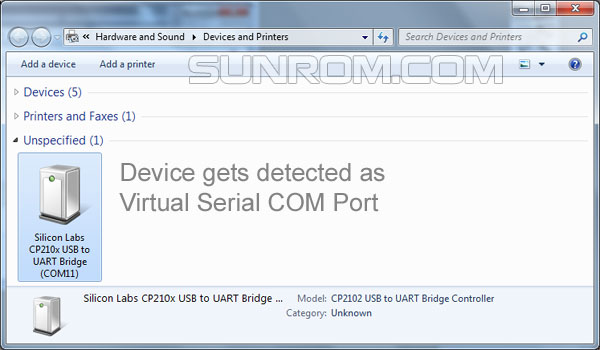
You can check the driver installation by following the following steps:. Go to Control panel and then Add or Remove Program, you should see the program 'Silicon Laboratories CP210x USB to UART Bridge (Driver Removal)' as shown below. Connect your device to the PC, turn it on and then go to the Device Manager (right click on Computer Manage Device Manager, you should see your device shown as 'Silicon Labs CP210x USB to UART Bridge (COMx).' If you unplug the device, the entry would disappear from the device manager screen.
If you do not see the USB to UART Bridge in the 'Add or Remove Program' list, your driver has not been installed. You would need to install the driver manually.
If you do not see the USB to UART Bridge in device manager, either the driver is not installed properly or there is a. Version conflict If your computer already has another version of the USB to UART Bridge installed, the new one may not installed properly. The newly installed software may not work with the latest version of the driver. For example, the CP210x driver from MedView would not work with SpO2 Assistant when we were doing the testing. The programs running on your PC are interfering with each other in accessing the COM port. One fix (see the section for more recommendations) is to remove the offending program; however this works only if you know this is the problem and the trick is to find out the offending programs. I am not aware of any easy way to determine the conflict.
There are a few things you can do to look for hints. Communication error messages (e.g. 'Read COM failed') when running a program. This program is a partner involved in the conflict.
Error messages during system or program startup. The program generating the error message is another potential candidate. Install the MKS software on another PC (preferably a clean PC without installed programs that uses the USB port). See next section on USB serial IO port conflict. For one particular case, on a computer we used for testing various devices, we finally decided to reinstall Windows to solve the problem. Problem software reported by our customers:. HotSync Manager from Palm.
Lifecam from Microsoft Possible fixes are:. Uninstall the offending program. Use another computer. Reinstall Windows. Isolate the conflicting devices to different instances of Windows using any of the following techniques:.: By installing multiple operating systems on the same computer, you can built a 'clean' one and run the software on this copy. The drawback is you would require extra disk space and at least two disk partitions, one for each copy. Virtual machine: See,.
Each virtual machine would run within its own environment and would eliminate any interference. When building a virtual machine, do not copy from one that contains the conflicting software. Installing Windows Virtual PC is actually rather simple if you have Windows 7 Professional or Ultimate. The following steps are obtained from.
The procedure is not as daunting as it sounds. Download Windows Virtual PC and Windows XP Mode installers from the (.
Install Windows XP Mode by double-clicking the file WindowsXPModenn-NN.exe (where nn-NN is the locale code, for example, en-US) and then completing the wizard that opens. Install Windows Virtual PC by double-clicking either of the files Windows6.1-KB958559-x86.msu or Windows6.1-KB958559-x64.msu, as appropriate for your processor type. Restart the computer. Once the computer has restarted, click Start, click Windows Virtual PC, and then click Windows XP Mode.
Complete the wizard that opens. Be sure that you record the password provided during the setup process because you will need it to log on to the virtual machine. These applications do not use a lot of resources. Any old computer running WXP would work.
If you encounter any software conflict, just re-install Windows to get a clean machine. Please if you find another conflicting software. You should try to install the software on another computer first to verify the problem before trying multi-boot or virtual machine. These two approaches, though not difficult, require some expertise in installing Windows. There are many other advantages in running multiple instances of Windows on one computer, which has saved us many times in the past.
If the computer has multiple installed software (e.g. Webcam, MP3 player, PDA) that uses USB serial IO, they may interfere with each other.
For example, an installed driver may think that a COM port is assigned to it even if the USB device is not connected and keep on sending data to the COM port. Another driver thinks that the COM port is available as there is no connected device and would start using it. To find out which USB devices are causing problem, connect them all to the computer. Run and test them together. Look for error messages and strange behaviors. You would need to uninstall both the software (MKS) and driver manually prior to any reinstallation. Connect the device to the computer.
Ft232r Usb Uart Driver
Start up Device manager and look for an entry Silicon Labs CP210x USB to UART Bridge (under Ports, see diagram above). Right click on the entry and select 'Uninstall'. Check the 'Delete the driver software for this device' box and click 'OK'. Go to control panel add/remove program.
Silabs Usb Uart Driver For Mac

Uninstall the software (Medview, SpO2 Assistant). Uninstall all items related to the Silicon Laboratgories CP210x driver (there may be multiple entries for the driver). You may want to reboot the system at this point prior to reinstalling the software. After installing the software, restart the system to finalize the install. Remove the installed CP210x driver from 'Add/Remove Program' and device manager prior to the reinstallation (see the section above for details). The Keep-it-Easy software combines all the modules and driver into one executable and the driver cannot be installed separately.
One has to reinstall everything. For MedView, there is a program 'setup.exe' within the usbDriver folder in the CD.
Execute this program to reinstall the driver only. Remember to remove the driver first using the 'Add & Remove Program' in control panel. For SpO2 Assistant, you can download the driver form page. Installing the driver is a two-step process. At the end of the first step, remember to check the box labeled 'Launch the CP210x VCP Driver Installer' prior to clicking the Finish button.
The second step is the actual installation of the driver into Windows. Software cannot find the port (MedView) Start MedView and go to the New Data Capture screen, click 'Extended' and manually select the appropriate port. The correct port is the one shown in Device Manager. For example, in the above diagram, the port is COM4. No data Take a few measurements and try again. MAC You would need to find a Windows-based computer.
Help Please if you want to join into this ongoing study.